Brandt's Stasi Shadowman
On one side of the Iron Curtain, Günter Guillaume was considered a national hero. On the other side, a traitor. For years, Guillaume had lived in West Germany as a spy rising up the ranks of politics.

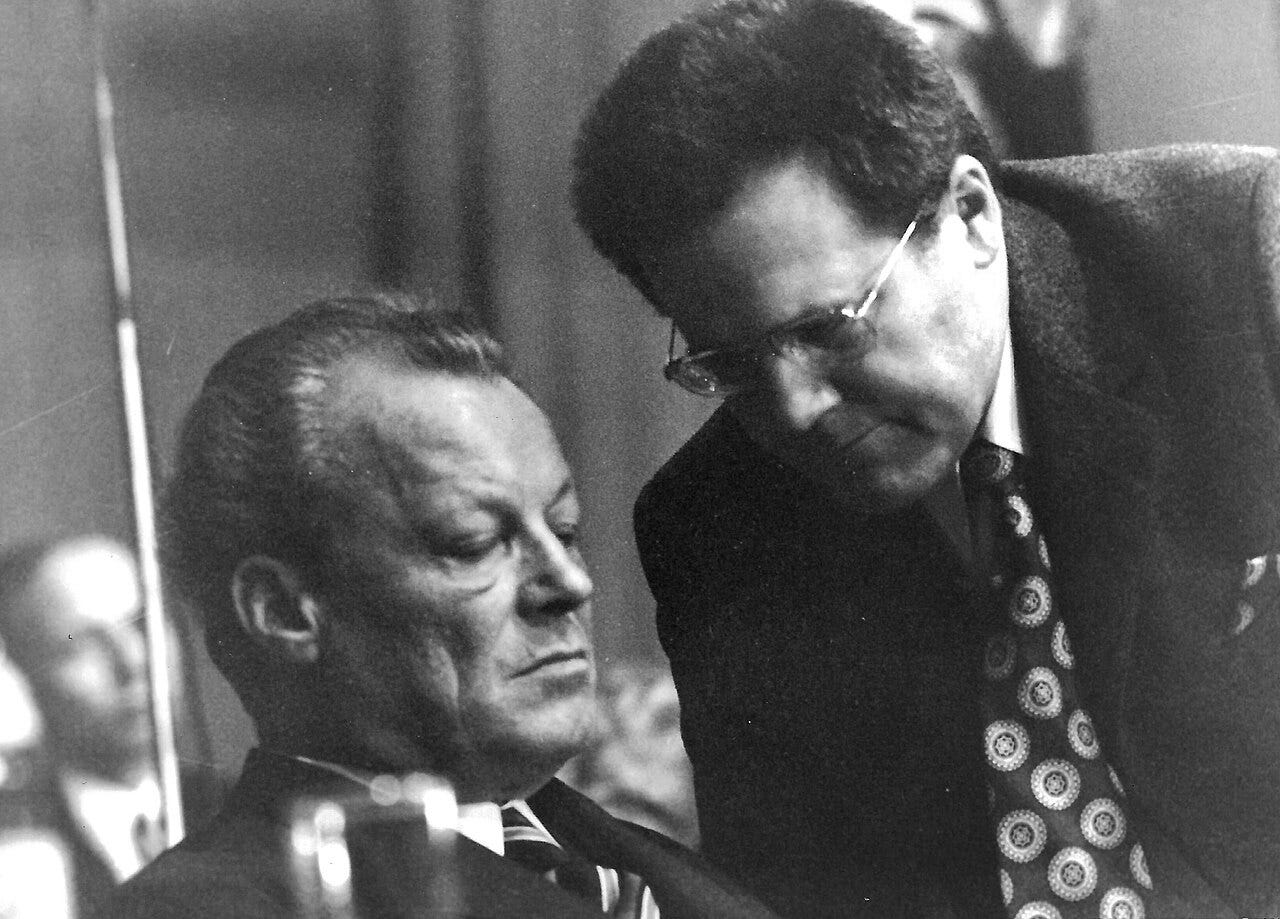

When Günter Guillaume first arrived in West Germany, no one expected him to eventually rise within the political spectrum as he did. Sent from the GDR to the West by his spymaster, Markus Wolf in 1956, his mission was to infiltrate the SDP (Socialist Democratic Party) and to send information back home so that the GDR could keep a tab on what was going on. Yet, for 18 years, both Günter and his wife Christel had somehow found themselves with a direct ear to the West German Chancellor himself. Like any good spy, Günter continued what he was doing. Arousing suspicion at this stage would be disastrous not only for him, but also for the fragile relationship between East and West Germany.
However, continuing as normal would come to an abrupt halt on the 24th April 1974 as the Police searched the Guillaume residence. The pair were arrested on suspicion of espionage in Bonn, with Gunter declaring his rights by saying: “I am a citizen and officer of the GDR. Do respect that.”
Before the pair were sent out on their mission, Günter had already been working with the Stasi. In the early 1950’s, he was previously sent to West Germany although his actual assignments in those early days of his espionage career are not truly known. However, it was enough to impress his handlers. Christel had met Günter long before their eventual move to the West. It was a fast-moving relationship that saw the pair engaged within only a few months before tying the knot in 1951. Soon, the couple would use their relationship for one of the most sensational moves of their lives.
Training at the Main Directorate for Reconnaissance (HVA) would soon begin. Officially formed in 1955, the HVA was seen as an integral part of the Stasi which focused on all operations outside of the GDR. As a married couple, it was believed that the Guillaume’s would be perfect to travel to the West arousing less suspicion then a single person. Here they were trained in the art of infiltration and other skills including political, military, economic and technological intelligence-gathering.
The Guillaumes still had to enter West Germany in a way not alert the authorities. For this, they used Christel’s mother, Erna. With Erna carrying a Dutch Passport she could enter West Germany without any checks. Posing as refugees, the Guillaume’s would follow after Erna had established herself within the country. This worked and now Erna could write to the authorities requesting that her daughter and son-in-law be granted official refugee status. Rather than finding themselves in a refugee camp, they could simply register at a local police station. Because of this, they were able to avoid the normal checks. Reunited with Erna, the process of infiltration could begin.
The pair would soon begin to infiltrate the SPD. Christel would secure the position of secretary at the SPD office in Frankfurt before gaining a promotion to work alongside Willi Birkelbach, the regional chairman. As a member of the Bundestag, Christel was able to gain valuable information regarding NATO that she duly passed on to the Stasi.
Whilst Christel was making inroads herself, Günter was also making a name for himself. Elected to the Frankfurt City Council in 1968, he would also go on to become the campaign manager for Georg Leber who would go on to become the defence minister for West Germany. It was an impressive rise through the political system for the East German pair but soon Gunter would attract the attention of the most powerful man in West Germany.
Willy Brandt became Chancellor of West Germany in 1969. One of Brandt’s key policies had a direct impact on the East. Ostpolitik was a change of direction for West Germany. Prior to Brandt taking office the previously dominant CDU (Christian Democratic Union) had viewed the East with suspicion and combated the East’s governance. With Ostpolitik, Brandt had aimed to smooth relations, opting to achieve a degree of cooperation with the East. Günter, now within the inner circle of West German politics as one of Brandt’s key aides, was now reporting back to the east about the mood of the West German government towards them.
It would be wrong to believe that the Guillaumes were never under any form of suspicion. Since their arrival, Gunter had been suspected of working for the other side of the Iron Curtain. As early as 1955, doubts were raised, reports were made but they were dismissed. Even his promotion to Brandt’s offices raised red flags but not enough evidence could be found. For now, the pair were doing enough to evade the authorities.

It would be Guillaume’s own handlers who would eventually lead to the discovery of the pair’s activities. The bureaucratic nature of the Stasi had seen it form some rather unusual traits. One such trait was to wish their sleeper agents a radio birthday message and also to send a message of congratulations when couples gave birth. Whilst this may seem like a positive gesture to improve the morale for their agents, it was also unusual given that the Guillaumes had apparently defected on their own accord. If they had done so, then why were they receiving messages like this from the east?
The radio messages were picked up by West German intelligence. Upon further analysis, they were traced to their source. Now the Guillaumes were under the radar. Becoming aware of the situation, they contacted their superiors who swiftly told them to stop all operations. They now had two options: to stay in the West or return to the East. They opted to stay, hoping that the situation would change. After all, it wasn’t the first time they had gotten away with it.
Politically, there was panic within the office of Willy Brandt. How could a mole penetrate so deeply into the West German government? What did this say about the policy of Ostpolitik? More importantly though, what did it tell the world about the judgment of its Chancellor?
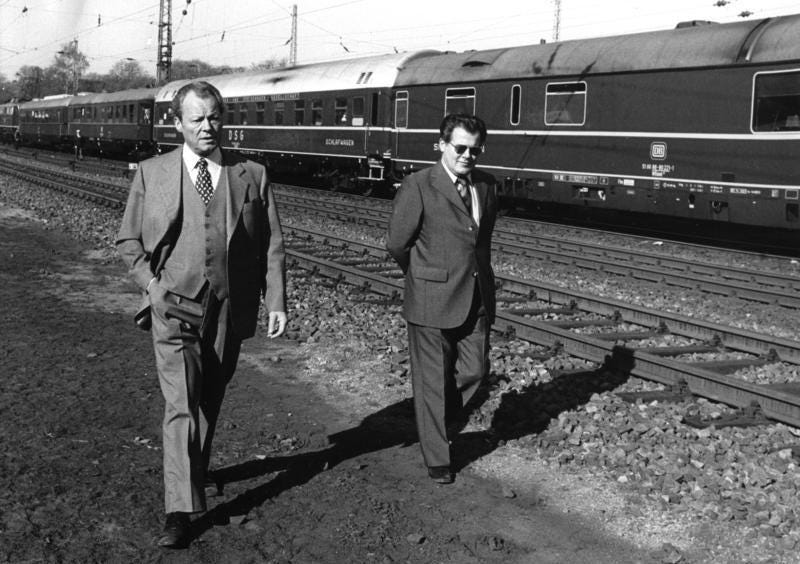
Time was needed to delay the inevitable. Rather than arresting the Guillaumes straight away, more time was needed. Things continued as normal with Brandt, even taking a personal vacation with Gunter by his side.
The arrest at their home in Bonn would lead to Brandt’s resignation only weeks later. His association with the Guillaimues was too much politically.
Since his resignation and the trial of the Guillaumes, there has been speculation as to the significance and the motive of the affair. Brandt believed that individuals within his own party allowed for the rise of Gunter Guillaume in order to undermine him and his policy of Ostpolitik.
Markus Wolf, the head of operations in East Germany, insists that Brandt really quit because his own party used the spy scandal to blackmail him over his many sexual liaisons. Brandt’s wandering eye may have been a motive but there was no doubting the implications for his resignation in the East. Wolf later admitted that the operation was a disaster for both sides of Germany, saying it was the ‘’equivalent to kicking a football into our own goal.’‘
For both sides, the tension would resurface. It is hard to know just how successful Brandt’s policy towards the East would have fared. However, his opinion of Günter Guillaume describes a man who Brandt felt was just there in the background.
“Guillaume was not someone who actually took part in political discussions, only a reliable aide; not a partner in serious conversation but a good, methodical worker. As I have told the chief of the service involved, I did not especially like his company near me or for very long.”
Guillaume returned to the East in 1981 following a prisoner exchange for Western spies caught in the East. Christel would divorce him soon after claiming that he said too much during his interrogation. Both would be celebrated as heroes in the GDR. Gunter in particular, would forever be remembered as the spy who brought down a Chancellor. Willy Brandt’s Stasi shadowman.